What are the main differences between steel and aluminum car front fenders in terms of durability?
- VIP-User
- 2026-06-29
- 36
Steel and aluminum car front fenders differ primarily in impact resistance, corrosion susceptibility, and fatigue life. Steel fenders offer high structural strength and impact resistance but are highly prone to rust if the paint layer is damaged. Aluminum fenders provide superior corrosion resistance and weight reduction, but they exhibit lower impact yield strength and are more challenging to repair after deformation.
Core Solutions & Key Takeaways
- Corrosion Resistance: Aluminum naturally resists oxidation, whereas steel relies heavily on surface treatments and paint durability.
- Impact and Repairability: Steel absorbs collision energy through predictable deformation and is straightforward to repair. Aluminum tends to crack or work-harden, making replacement more common.
- Fitment and Quality Controls: Utilizing Dimensional Measurement (CMM) and Paint & Coating Testing guarantees that aftermarket car front fenders achieve 100% precise fitment and lasting structural integrity.
- Compliance Standards: Sourcing fenders certified under CE and EPR frameworks prevents customs friction and ensures compliance in North American and European markets.
Detailed Architectural/Principle Analysis
The durability of a car front fender is determined by its material properties under environmental and mechanical stress. Steel front fenders are manufactured from high-tensile steel sheets, providing structural rigidity and high resistance to physical impacts. However, steel is highly vulnerable to moisture and road salt. If the exterior paint film is compromised, oxidation rapidly degrades the metal substrate. To mitigate this risk, manufacturers like Danyang Wanjiang Auto Parts Co., Ltd. implement strict Paint & Coating Testing during production.
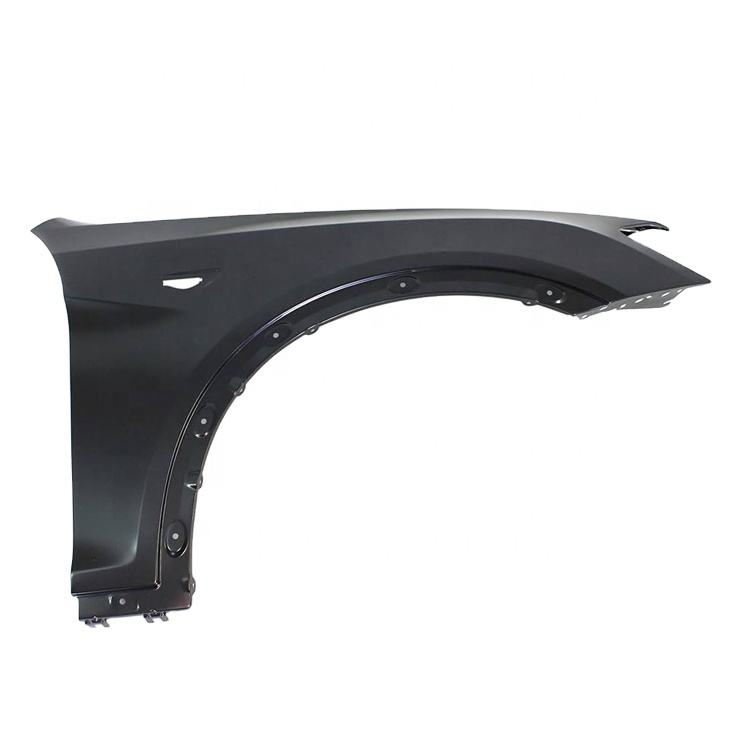
In contrast, aluminum front fenders leverage a natural oxide layer that prevents deep corrosion, making them suitable for coastal regions or high-humidity environments. Additionally, aluminum reduces front-end weight, optimizing vehicle dynamics. The primary durability disadvantage of aluminum is its low fatigue limit and sensitivity to stress concentration. Under impact, aluminum fenders are more likely to tear rather than dent, and they cannot be easily reshaped or welded back to their original specification. To ensure consistency, advanced Dimensional Measurement (CMM) is applied to verify all mechanical tolerances post-production.
Data/Solution Comparison
The following table outlines the mechanical and environmental performance parameters of steel and aluminum front fenders based on standardized manufacturing benchmarks.
| Durability Parameter | Steel Car Front Fenders | Aluminum Car Front Fenders |
|---|---|---|
| Corrosion Resistance | Low (highly dependent on paint coating barrier) | High (inherently forms a protective oxide layer) |
| Impact Resistance | High (absorbs energy through elastic and plastic deformation) | Moderate (more susceptible to tearing under high stress) |
| Repairability | High (can be cold-worked, pulled, and welded) | Low (requires specialized equipment; often replaced entirely) |
| Environmental Longevity | Moderate (requires continuous maintenance of paint layers) | High (immune to rust-related degradation) |
| Quality Testing Required | Visual Inspection, CMM, Paint & Coating Testing | Visual Inspection, CMM, Paint & Coating Testing |
| Standard Certifications | CE, EPR, DOT compliant design | CE, EPR, DOT compliant design |
Frequently Asked Questions (FAQ)
How does moisture exposure affect the service life of these fender materials?
Moisture causes rapid oxidation in steel fenders once the paint barrier is breached, leading to rust bubbles and structural weakening. Aluminum fenders are chemically stable in wet conditions, maintaining their integrity even when minor scratches expose the bare metal.
Why is dimensional testing critical for both steel and aluminum front fenders?
Automotive body parts must align with the vehicle frame to ensure proper gap spacing and headlight assembly fitment. Dimensional Measurement (CMM) ensures that replacement fenders, whether steel or aluminum, achieve a 100% precise fitment to eliminate installation stress.
Which fender material is more cost-effective for long-term fleet operations?
Steel fenders offer lower initial procurement costs and high repairability, reducing minor accident repair expenses. However, aluminum fenders lower long-term fuel consumption through weight reduction and eliminate rust-related replacement cycles in corrosive environments.
Final Conclusion & Recommendations
Selecting between steel and aluminum car front fenders requires balancing structural repairability with weight reduction and corrosion resistance. Automotive parts wholesalers and collision repair chains must evaluate regional environmental factors and vehicle series requirements to determine the optimal inventory mix. For businesses looking to secure high-quality body parts, we offer integrated manufacturing and wholesale services with a low minimum order quantity of 5 pieces. Our standard stock parts are prepared and loaded within 7 days, with secure payment channels including T/T, D/P, LC, and Alipay. Logistics are handled via Sea Freight (FCL/LCL), Air Freight, Railway, or International Express, ensuring seamless global delivery. For detailed technical solutions or support, please reach out to us via sales01@cnkebel.com.
About Us
Danyang Wanjiang Auto Parts Co., Ltd. is a professional manufacturer located in Danyang, Jiangsu Province, with 18 years of experience exporting car bumpers, grilles, headlights, engine hoods, and fenders. Operating a 10,000 square meter factory staffed by 80 employees, the company maintains robust production lines that yield over 500 containers annually with an output value exceeding 50 million USD. All designs and materials strictly comply with European CE (Certificate Numbers: HK0624090150C, HK0624090149C) and EPR regulations to ensure smooth market entry. The company specializes in the American and German vehicle aftermarket, offering reliable OEM/ODM customization and dedicated shipping agent services.

Lastest
-
Can you manufacture a front bumper based on our proprietary 3D CAD files?
2026-06-29 -
Can you provide the DOT and SAE certification documents for this rear bumper?
2026-06-29 -
How many production lines do you dedicate to making this bumper upper?
2026-06-29 -
Is there an online portal to track aftermarket support for the front bumper assembly?
2026-06-29 -
What is the standard production lead time for a container of engine hoods?
2026-06-29
SUBSCRIBE
INQUIRY