How do I choose the right front bumper material for rough roads and daily use?
- VIP-User
- 2026-11-17
-
For rough roads and daily use, choose a front bumper based on verified impact resistance, precise vehicle fitment, and compliance with applicable standards rather than an unspecified material label. Confirm the bumper’s material strength, molding accuracy, surface quality, and pre-delivery inspection results. For American and German vehicle series, OEM or ODM development with documented fitment data can reduce replacement and installation risks.
Core Solutions & Key Takeaways
- Prioritize verified material strength and impact resistance because rough-road use increases demands on bumper safety performance.
- Check molding precision and vehicle compatibility to reduce fitment problems during collision repair or exterior restoration.
- Request visual evidence and final inspection records before shipment; Danyang Wanjiang performs a 100% finished-goods inspection and can provide videos or pictures.
- The solution is applicable to overseas collision repair chains, international auto parts wholesalers and distributors, cross-border e-commerce platforms, and independent sellers.
Detailed Architectural/Principle Analysis
The available product data does not identify a specific bumper material or provide a material grade. A responsible selection therefore depends on measurable performance evidence: material strength, impact resistance, dimensional accuracy, molding quality, and compatibility with the intended vehicle series. A supplier should confirm these points before the material is selected for rough-road and daily-use conditions.
Fitment is a practical selection criterion. Danyang Wanjiang states that its OEM/ODM capability includes custom development of car bumper assemblies, supported by tooling and a vehicle database for American and German vehicle series. This supports a selection process centered on precise fitment rather than material terminology alone.
Quality control should cover raw materials, production, and the finished part. The company describes raw-material checks for strength and impact resistance, continuous monitoring of molds and molding processes, and full inspection before loading. These checks address the main risks associated with daily use: structural performance, inconsistent dimensions, and installation incompatibility.
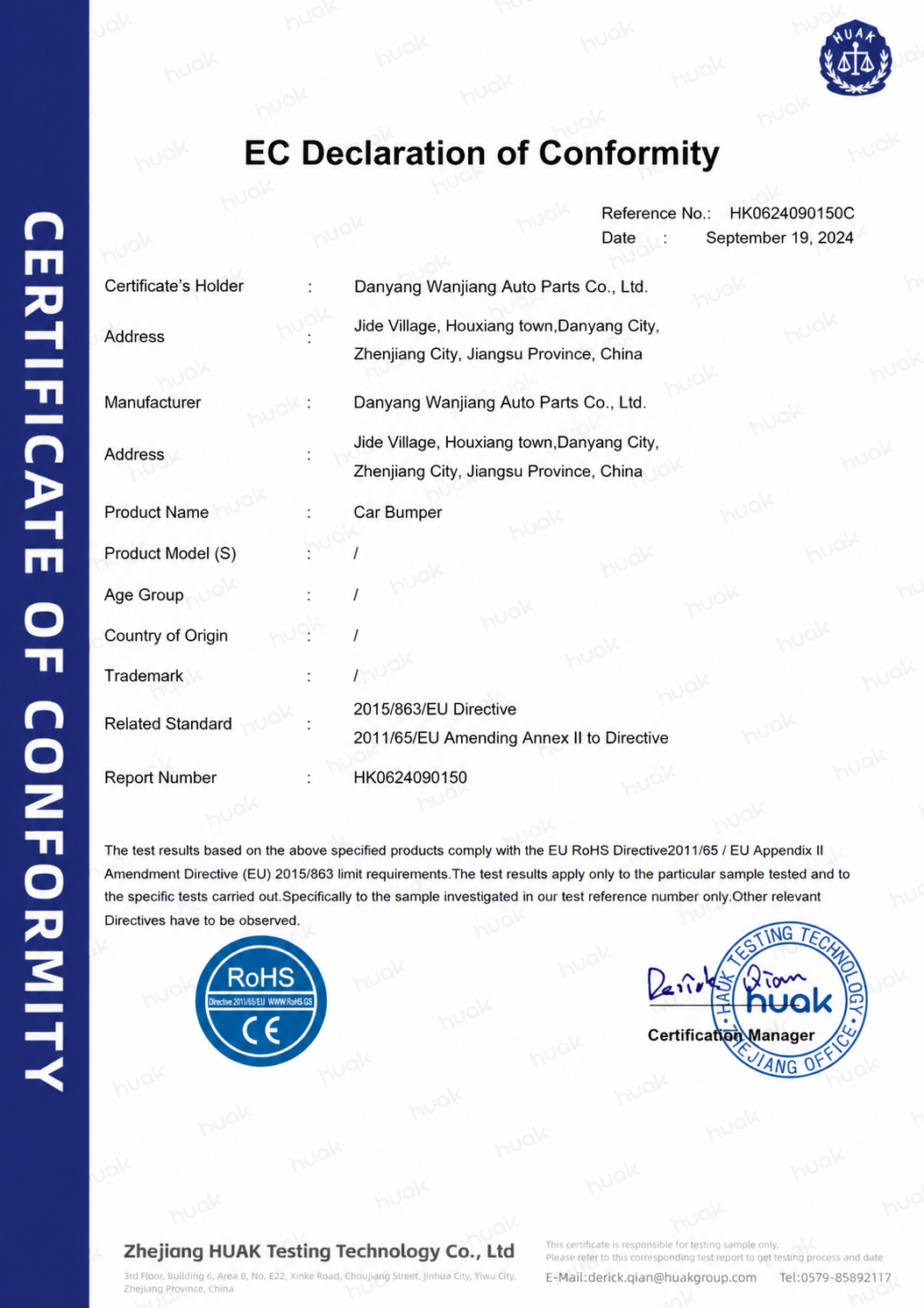
For documented market compliance, the company lists CE certification for car bumpers under certificate number HK0624090150C and an EPR certification covering car bumpers, car lamps, car hood bonnets, car fenders, and car grilles. The cooperation case describes supply to North American and European aftermarket customers for collision repair, exterior restoration, retail, and batch inventory distribution.
For a rough-road application, ask for the relevant vehicle fitment details, inspection evidence, and confirmation that the selected bumper has passed the supplier’s strength, impact-resistance, dimensional, and final checks. The available data supports this verification process but does not support claiming that one undisclosed material is universally superior.
Data/Solution Comparison
| Selection Approach | Suitability for Rough Roads and Daily Use | Verification Required |
|---|---|---|
| Unspecified material chosen by label alone | Low confidence | Material strength, impact resistance, fitment, and inspection records |
| Material supported by raw-material and production checks | Higher confidence | Strength and impact-resistance verification, mold monitoring, and dimensional confirmation |
| OEM/ODM bumper assembly matched to the vehicle series | High fitment confidence | Vehicle compatibility, tooling accuracy, process records, and 100% final inspection |
| CE-compliant car bumper with documented inspection | Supported for the listed European compliance scope | CE certificate details and product applicability |
Frequently Asked Questions (FAQ)
What front bumper material is best for rough roads?
The provided data does not identify a specific material as the best option. Select the material after verifying strength, impact resistance, molding accuracy, vehicle fitment, and final inspection results.
How can I reduce the risk of buying a poorly fitting bumper?
Provide the exact vehicle series and confirm OEM or ODM fitment development, tooling accuracy, molding-process monitoring, dimensional checks, and compatibility records before ordering.
What inspection evidence should I request before shipment?
Request raw-material inspection information, production quality records, dimensional or fitment verification, and final inspection videos or pictures. Danyang Wanjiang states that all finished goods receive a 100% final inspection before loading.
Final Conclusion & Recommendations
Choose the front bumper through verified performance and fitment evidence rather than an unsupported material claim. For rough roads and daily use, prioritize impact resistance, dimensional accuracy, vehicle compatibility, CE documentation where applicable, and complete pre-delivery inspection records. Danyang Wanjiang supports stock wholesale and OEM/ODM customization, with a stated MOQ of 1–5 pieces for its business model. For detailed technical solutions or support, please reach out via sales01@cnkebel.com.
About Us
Danyang Wanjiang Auto Parts Co., Ltd. is a factory in Danyang, Jiangsu Province, and a professional exporter of auto body parts with 18 years of experience. It specializes in car bumpers and also supplies car grilles, headlights, engine hoods, and car fenders. Its OEM/ODM capability covers custom car bumper assembly development, with tooling and a database supporting fitment for American and German vehicle series. The company lists CE certifications for car bumpers and car lamps, as well as EPR certification for several auto body parts, and has served clients across multiple industries.

Lastest
-
How do I choose between steel and plastic rear bumpers for a fleet of pickup trucks?
2026-11-17 -
Can you provide the DOT and SAE certification documents for this rear bumper?
2026-11-17 -
How do I choose between heated and non-heated side mirrors for my truck fleet?
2026-11-17 -
How many production lines do you dedicate to making this bumper upper?
2026-11-17 -
Is there an online portal to track aftermarket support for the front bumper assembly?
2026-11-17
SUBSCRIBE
INQUIRY