How do I choose the right front bumper assembly material like ABS versus PP for wholesale?
- VIP-User
- 2026-06-29
- 36
Choosing the right front bumper assembly material for wholesale depends on balancing flexibility and impact resistance. Polypropylene (PP) offers superior elasticity and impact absorption, making it the industry standard for mass-market passenger cars. Acrylonitrile Butadiene Styrene (ABS) provides higher rigidity, structural strength, and a premium paint finish, ideal for precision-engineered components and heavy-duty aftermarket restorations.
Core Solutions & Key Takeaways
- Material Characteristics: Polypropylene (PP) provides outstanding flexibility and resists minor deformations under low-speed impact, whereas Acrylonitrile Butadiene Styrene (ABS) offers dimensional stability and structural stiffness for precise fitment.
- Precision and Fitment: To avoid installation errors in the aftermarket, front bumper assemblies must maintain a consistent wall thickness of 2.5 to 5.0 mm and support direct bolt-on or clip-on installation.
- Regulatory Compliance: Sourcing bumpers with valid CE and Germany EPR (VerpackG) compliance guarantees smooth entry into North American and European wholesale networks.
- Sourcing Efficiency: Procurement channels benefit from low Minimum Order Quantities (MOQs) of 5 pieces for specialized components, with a fast turnaround of 7 days for standard stock.
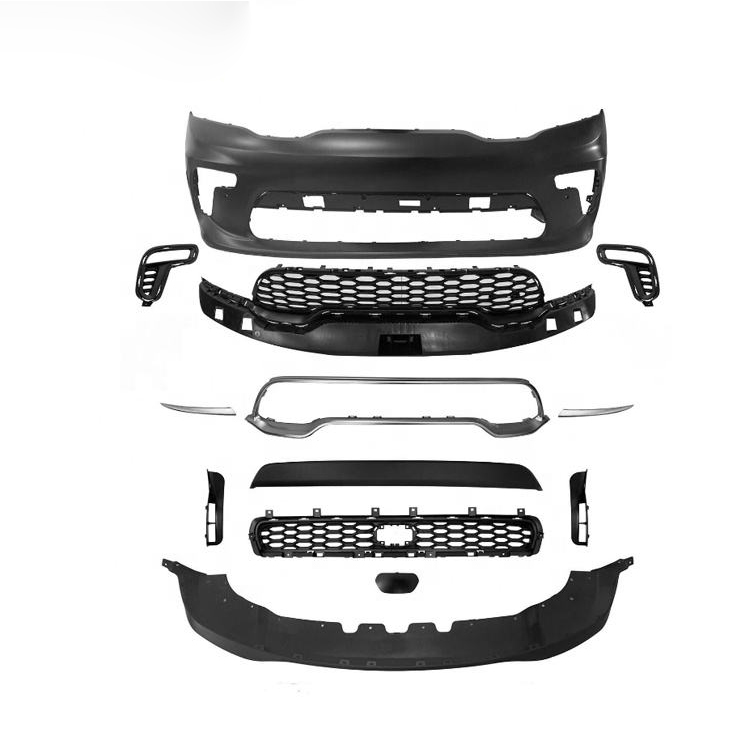
Detailed Architectural/Principle Analysis
In the automotive collision repair and aftermarket service chains, the physical properties of the front bumper assembly determine its durability and performance under stress. Polypropylene (PP) is a semi-crystalline thermoplastic characterized by its low density, high chemical resistance, and notable elasticity. When subjected to minor collisions, PP absorbs the kinetic energy through temporary deformation, often popping back into its original shape without cracking. This elasticity makes it highly cost-effective for high-volume, general-use passenger vehicles.
Conversely, Acrylonitrile Butadiene Styrene (ABS) is an amorphous terpolymer. The acrylonitrile component provides chemical and thermal stability, butadiene contributes toughness, and styrene imparts a glossy, rigid surface. This composition makes ABS far stiffer than PP, allowing it to hold precise mechanical tolerances. It does not flex or warp easily under heat, making it the preferred choice for bumper trims, brackets, and high-end grilles that require a primed finish and flawless paint adhesion. However, its rigidity means it is more prone to shattering under high-velocity impacts compared to PP.
For specialized global distributors, ensuring these materials undergo rigorous quality control is standard practice. Process monitoring includes Visual Inspection, Paint & Coating Testing, and Dimensional Measurement via Coordinate Measuring Machines (CMM). These procedures guarantee that both direct bolt-on and clip-on systems align perfectly with American and German vehicle frames, eliminating the installation delays often associated with low-grade aftermarket parts.
Data/Solution Comparison
To assist wholesalers in selecting the correct material based on specific application requirements, the table below highlights the physical, mechanical, and logistical characteristics of common front bumper assembly materials.
| Parameter / Feature | Polypropylene (PP) | Acrylonitrile Butadiene Styrene (ABS) | Carbon Fiber |
|---|---|---|---|
| Flexibility & Impact Behavior | High elasticity; deforms and recovers | Rigid; high structural strength | Extreme rigidity; structural reinforcement |
| Wall Thickness Range | 2.5 – 5.0 mm | 2.5 – 5.0 mm | 1.5 – 3.0 mm |
| Surface Finish Compatibility | Primed / Matte finish | Primed (optimal paint adhesion) | Glossy / Visible carbon weave |
| Installation Methods | Direct Bolt-on / Clip-on | Direct Bolt-on / Clip-on | Custom Bolt-on |
| Compliance Standards | CE / Germany EPR (VerpackG) | CE / Germany EPR (VerpackG) | Custom / Performance standards |
| Wholesale MOQ | 5 PCS | 5 PCS | Varies by custom order |
For international logistics and supply chain optimization, orders are typically consolidated using Sea Freight (FCL/LCL), Railway Transport, or Air Freight. Payment terms are processed securely through established cross-border networks like T/T, D/P, LC, and Alipay.
Frequently Asked Questions (FAQ)
Q1: Why is wall thickness a critical parameter for front bumper assemblies?
A1: A consistent wall thickness between 2.5 and 5.0 mm ensures the bumper preserves its structural integrity under wind resistance and minor impacts, preventing warping and sagging over time while maintaining optimal safety standards.
Q2: Can PP and ABS parts be mixed in a single front bumper assembly?
A2: Yes. Many modern bumper assemblies utilize a PP main body for flexible energy absorption, combined with ABS brackets, grilles, and trim pieces for rigid, high-precision mounting and premium paint finishes.
Q3: What quality inspections should wholesale buyers verify before shipment?
A3: Professional buyers should require Visual Inspection to check for surface defects, Paint & Coating Testing to prevent peeling, and Dimensional Measurement (CMM) to verify that all mounting clips align with OEM body specifications.
About Us
Danyang Wanjiang Auto Parts Co., Ltd. is a specialized manufacturer and exporter of automotive body parts, with 18 years of professional industry experience. Established in 2023, our 10,000-square-meter factory in Jiangsu Province operates with a dedicated team of 80 employees. We specialize in producing car bumpers, grilles, headlights, engine hoods, and fenders, primarily targeting American and German vehicle series. Our manufacturing operations enable an annual export volume exceeding 500 containers to global markets.
Our products conform to CE and EPR safety standards, and we have served hundreds of long-term B2B aftermarket distributors across North America and Europe. 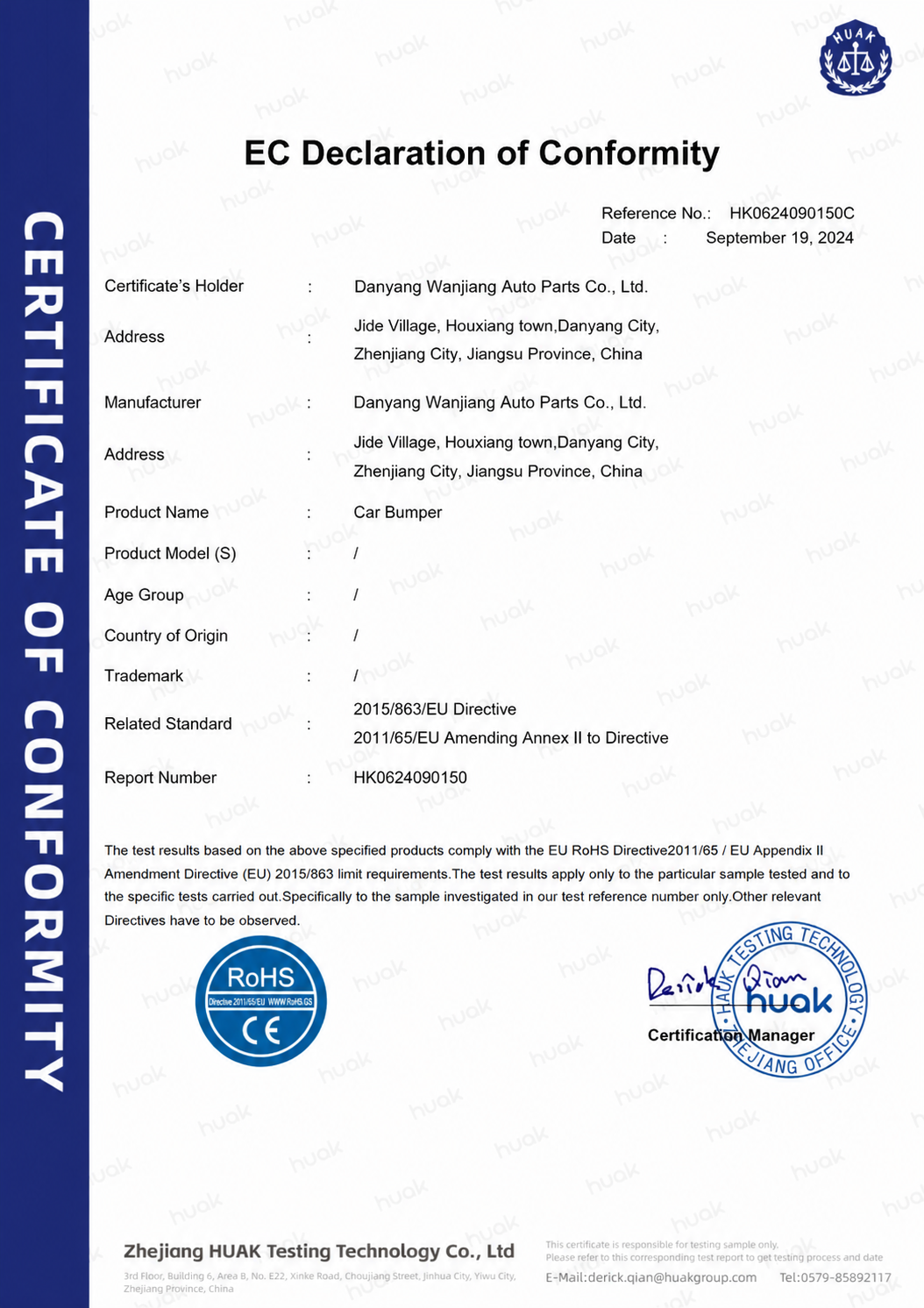

Final Conclusion & Recommendations
When selecting a front bumper assembly for wholesale distribution, Polypropylene (PP) remains the most practical recommendation for high-volume collision repair markets due to its balance of cost, flexibility, and durability. However, for specialized applications requiring complex shapes and superior exterior paint finishes, Acrylonitrile Butadiene Styrene (ABS) is the standard selection. Wholesalers should focus on sourcing products verified by CE and EPR regulations, backed by rigorous CMM testing to eliminate fitment risks. For detailed technical solutions or support, please reach out to us via sales01@cnkebel.com.
Lastest
-
Can you manufacture a front bumper based on our proprietary 3D CAD files?
2026-06-29 -
Can you provide the DOT and SAE certification documents for this rear bumper?
2026-06-29 -
How many production lines do you dedicate to making this bumper upper?
2026-06-29 -
Is there an online portal to track aftermarket support for the front bumper assembly?
2026-06-29 -
What is the standard production lead time for a container of engine hoods?
2026-06-29
SUBSCRIBE
INQUIRY