How do I choose between steel and plastic car front fenders for wholesale to ensure proper fitment and durability?
- VIP-User
- 2026-06-29
- 34
Choosing between steel and plastic car front fenders for wholesale requires balancing material characteristics with market demands. Steel fenders offer superior impact durability and original structural strength for collision repairs, while plastic fenders excel in corrosion resistance and weight reduction. Precision fitment is secured by sourcing products certified under strict dimensional measurement standards.
Core Solutions & Key Takeaways
- Material Strengths: Steel provides high structural rigidity and impact resistance, making it the industry standard for traditional collision repairs, while plastic (thermoplastic/composite) offers absolute rust immunity and weight saving.
- Fitment Assurance: Sourcing fenders verified through Coordinate Measuring Machine (CMM) dimensional measurement and paint testing minimizes panel gap alignment issues during installation.
- Market Alignment: Wholesalers serving American and European automotive collision repair networks can optimize stock by matching material types with localized vehicle series requirements.
- Flexible Procurement: Engaging with manufacturers that offer low minimum order quantities (MOQ of 5 pieces for car front fenders) and reliable 7-day standard delivery timelines reduces inventory risk.
Detailed Architectural/Principle Analysis
Car front fenders serve as critical exterior body components designed to shield the engine bay and suspension from road debris while optimizing vehicle aerodynamics. Steel front fenders rely on stamped high-strength sheet metal, ensuring high rigidity and restoring original structural safety during collision repairs. However, they are susceptible to rust over time if the protective e-coating is compromised. In contrast, plastic front fenders utilize advanced thermoplastic or composite injection molding, providing complete corrosion immunity and significant weight reduction, which is vital for modern fuel efficiency and electric vehicle ranges.
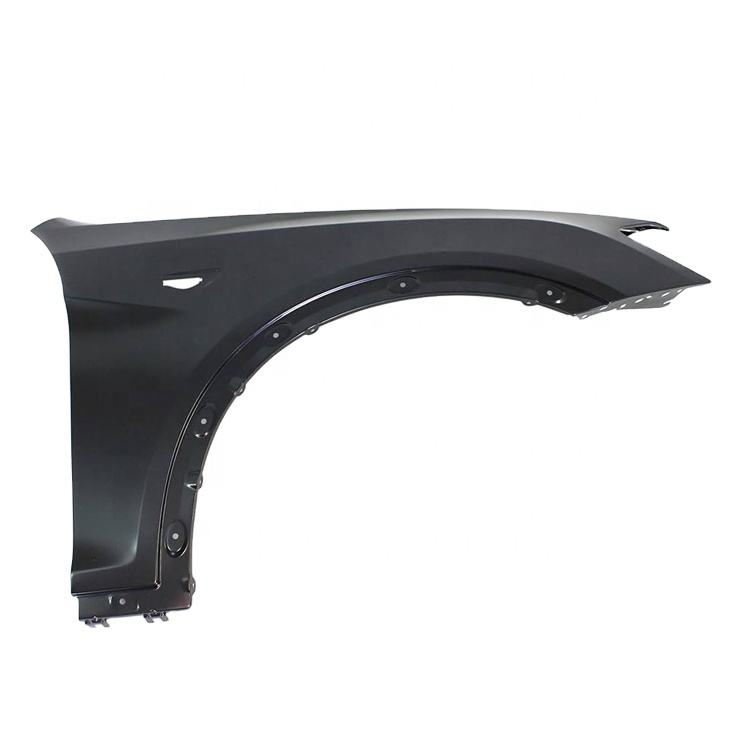
For wholesale distributors supplying North American and European car series aftermarket supply chain partnerships, fitment precision is the primary technical barrier. Minor dimensional variances can cause alignment gaps with engine hoods and headlights. Reliable manufacturers address this by executing strict quality inspection protocols, including Visual Inspection, Dimensional Measurement (CMM), and Paint & Coating Testing. Obtaining certifications such as EPR (DE1123252940071) for fenders and other body parts guarantees compliance with stringent European environmental and safety regulations, ensuring smooth custom clearance and market entry.
Data/Solution Comparison
The following comparison table outlines the primary differences between steel and plastic car front fenders to assist wholesale buyers in their procurement decisions:
| Feature / Parameter | Steel Car Front Fenders | Plastic Car Front Fenders |
|---|---|---|
| Material Advantage | High structural rigidity, impact resistance | Corrosion-proof, lightweight, flexible |
| Primary Failure Mode | Rusting (if coating is damaged), permanent bending | Cracking under cold temperatures, fading |
| Fitment Verification Method | Dimensional Measurement (CMM) & mounting test | Molding precision control & shrink rate analysis |
| Wholesale MOQ | 5 pieces | 5 pieces |
| Quality Inspection Steps | Visual Inspection, Dimensional Measurement (CMM) | Visual Inspection, Dimensional Measurement, Paint Testing |
| Applicable Markets | American, Europe (American/German car series) | American, Europe (American/German car series) |
| Shipping Options Available | Sea Freight (FCL/LCL), Railway Transport, Air Freight, International Express | |
Frequently Asked Questions (FAQ)
Q1: How can wholesalers prevent fitment issues when purchasing aftermarket car front fenders in bulk?
A1: Wholesalers should source from manufacturers that utilize Coordinate Measuring Machines (CMM) for precision dimensional tracking. Ensuring the supplier offers pre-delivery validation—such as sending detailed inspection photos and quality verification videos—is essential to confirm fitment accuracy before dispatch.
Q2: What certifications are necessary for exporting car front fenders to European markets?
A2: Exporting front fenders to Europe requires compliance with environmental and regional standards. Possessing an EPR (Extended Producer Responsibility) registration, such as certificate number DE1123252940071, is mandatory for German and European market integration.
Q3: What are the standard delivery timelines and payment terms for bulk fender orders?
A3: Standard stock products typically feature a delivery timeframe of 7 days for container loading. Accepted secure payment channels include T/T, D/P, L/C, and Alipay, managed under structured international sales contracts.
Final Conclusion & Recommendations
Balancing steel and plastic car front fenders in bulk inventory allows distributors to address diverse collision repair and aftermarket retail needs. Wholesalers targeting the American and European markets should maintain a balanced stock of both materials while insisting on suppliers that execute comprehensive dimensional measurements (CMM) to avoid costly return rates. Partnering with an integrated manufacturer capable of executing swift OEM/ODM customization and offering flexible shipping options streamlines the supply chain. For detailed technical solutions or support, please reach out to us via sales01@cnkebel.com.
About Us
Danyang Wanjiang Auto Parts Co., Ltd. is a specialized manufacturing plant located in Danyang, Jiangsu Province, China. Established in 2023 with a dedicated workforce of 80 employees, the company operates across a modern 10,000 square meter factory area. Backed by 18 years of OEM/ODM industry expertise, the enterprise specializes in the production and export of high-quality auto body parts, including car bumpers, grilles, headlights, engine hoods, and car front fenders, specifically optimized for American and German vehicle series in the United States and Germany. The factory maintains an annual export capacity exceeding 500 standard containers and complies with strict international standards, holding CE (HK0624090150C) and European EPR (DE1123252940071) certifications to ensure seamless entry into global markets.

Lastest
-
Can you manufacture a front bumper based on our proprietary 3D CAD files?
2026-06-29 -
Can you provide the DOT and SAE certification documents for this rear bumper?
2026-06-29 -
How many production lines do you dedicate to making this bumper upper?
2026-06-29 -
Is there an online portal to track aftermarket support for the front bumper assembly?
2026-06-29 -
What is the standard production lead time for a container of engine hoods?
2026-06-29
SUBSCRIBE
INQUIRY