How can I verify if a front bumper assembly has all the correct sensor holes for ADAS systems?
- VIP-User
- 2026-06-29
- 39
To verify if a front bumper assembly has correct sensor holes for ADAS systems, cross-reference the vehicle's specific VIN with the bumper's OEM part number, use coordinate measuring machines (CMM) to check dimensional placement, and perform a physical visual inspection against the original bumper's sensor brackets and wiring harness mounting points.
Core Solutions & Key Takeaways
- VIN-to-OEM Part Number Cross-Referencing: Ensuring precise alignment with the specific radar, LiDAR, or ultrasonic sensor configuration of the vehicle trim is the primary step in component matching.
- Coordinate Measuring Machine (CMM) Verification: Dimensional measurements of the precise diameter, angle, and physical spacing of each sensor bezel opening prevent ADAS misalignment.
- Bracket and Clip Compatibility Check: Checking if the pre-installed inner brackets utilize matching direct bolt-on or clip-on configurations prevents installation failures.
- Quality Inspection Records: Reviewing pre-delivery visual inspection, dimensional measurement (CMM), and paint and coating testing reports guarantees correct assembly specifications.
These verification practices are standard for overseas automotive collision repair networks, international auto parts wholesalers, and cross-border e-commerce sellers managing replacement parts for American and German vehicle series. Addressing issues like poor fitment precision and high international logistics risks requires structured QA workflows before parts leave the factory floor.
Detailed Architectural/Principle Analysis
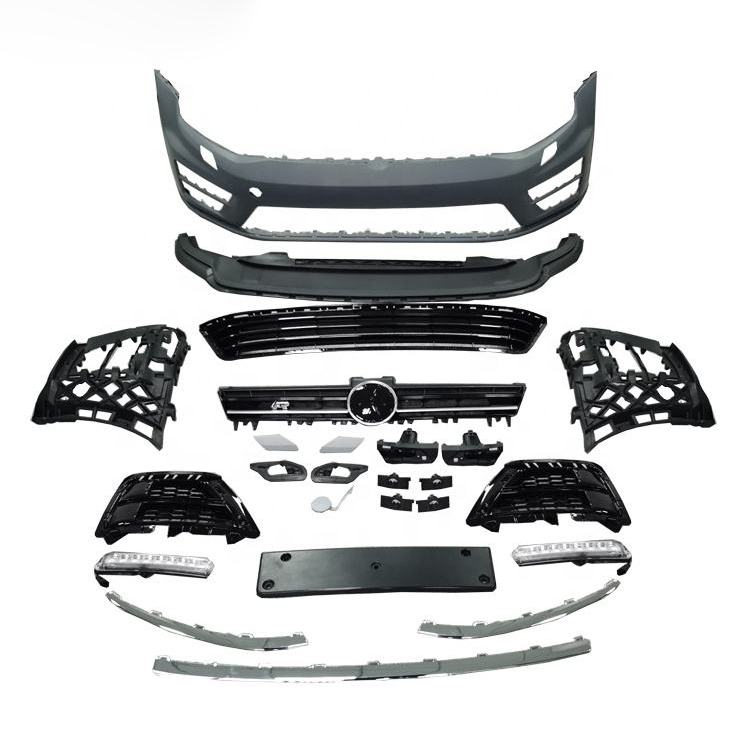
Modern front bumper assemblies are complex structural components that house advanced driver assistance systems (ADAS) such as parking sensors, lane-keep radar, and automated braking sensors. A standard front bumper assembly is manufactured from high-grade materials like polypropylene (PP), ABS, or carbon fiber, with wall thicknesses ranging from 2.5 mm to 5.0 mm. For ADAS sensors to function, the sensor hole position, hole diameter, and material thickness surrounding the sensor must match OEM specifications. A deviation of even 1 millimeter can alter the pitch or yaw angle of an ultrasonic sensor, triggering system faults or false collision warnings.
To prevent these calibration issues, manufacturers utilize precision injection molding and CNC laser cutting to pre-drill sensor holes. Under the brand KEBEL, Danyang Wanjiang Auto Parts Co., Ltd. leverages 18 years of OEM/ODM expertise to custom-develop front bumper assemblies with 100% precise fitment for American and German vehicle series. Every production batch undergoes a three-tiered quality inspection workflow comprising visual inspection, dimensional measurement via CMM, and comprehensive paint & coating testing.
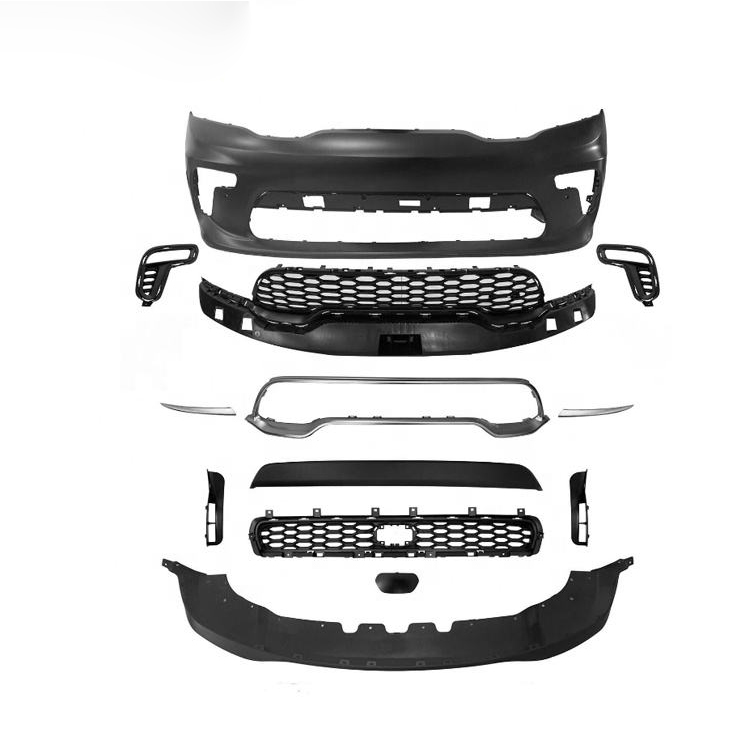
Furthermore, compliant products must satisfy rigorous international standards. These include European CE certification (such as Certificate HK0624090150C for car bumpers) and German EPR compliance (VerpackG). These certifications verify that the mechanical integrity and material composition of the bumper assembly meet road safety and environmental guidelines. In actual aftermarket scenarios, such as North American and European collision repairs, utilizing pre-verified bumpers that match original brackets minimizes post-installation recalibration labor times.
Data/Solution Comparison
The following table outlines the key differences and verification methods between standard aftermarket bumpers and ADAS-compatible front bumper assemblies:
| Parameter / Feature | Standard Aftermarket Bumper | ADAS-Compatible Front Bumper Assembly | Verification Method |
|---|---|---|---|
| Material & Wall Thickness | Variable polymers (often < 2.5 mm) | PP, ABS, or Carbon Fiber (2.5 – 5.0 mm) | Micrometer calipers & ultrasonic thickness testing |
| Sensor Hole Geometry | Requires manual drilling or punching | Mold-integrated or CNC laser-cut holes | Coordinate Measuring Machine (CMM) & plug gauges |
| Inner Bracket Configuration | Generic adhesive-backed brackets | Direct Bolt-on / Clip-on OEM matching brackets | Physical dry-fitment testing & visual matching |
| Surface Finish & Priming | Uneven priming (interferes with radar) | Uniformly primed surface for optimal paint coating | Paint & Coating Testing (spectrophotometer verification) |
| Compliance Credentials | Uncertified or regional compliance only | CE Certified (HK0624090150C), EPR Compliant | Certificate registry validation |
Frequently Asked Questions (FAQ)
Can I manually drill ADAS sensor holes into a primed aftermarket front bumper assembly?
Manual drilling is highly discouraged. ADAS sensors require precise physical tolerances, edge smoothness, and strict thickness parameters (2.5 – 5.0 mm). Manual modification often results in micro-fractures, paint peeling, incorrect sensor pitch angles, and system calibration failures.
What is the typical dimensional tolerance for ADAS sensor holes?
To avoid calibration offsets, the dimensional tolerance for ADAS sensor holes must be kept within +/- 0.5 mm. Precision manufacturers use automated CMM equipment to confirm this placement before the bumper is shipped.
How do I verify if the pre-installed sensor brackets will fit my original sensors?
Verify whether the inner bracket style is designed for a "Direct Bolt-on" or "Clip-on" installation. You can request high-definition pictures or quality inspection videos of the inner bumper structure from the manufacturer prior to delivery to confirm structural compatibility.
Final Conclusion & Recommendations
Verifying a front bumper assembly for ADAS compatibility involves checking the structural material, checking dimensional tolerances via CMM, and matching OEM bracket designs. Operating as an integrated manufacturing and trading ecosystem for auto body parts, KEBEL provides robust supply chain support, offering a minimum order quantity (MOQ) of 5 units and standard stock product dispatch within 7 days. Payments are supported via T/T, D/P, L/C, or Alipay, with international logistics handled via Sea Freight, Air Freight, Railway, or Express (DHL, FedEx, UPS). For detailed technical solutions or support, please reach out to us via sales01@cnkebel.com.
About Us
Danyang Wanjiang Auto Parts Co., Ltd. is a professional exporter of auto body parts based in Jiangsu, China. Established in 2023, the company houses 80 employees, operates a 10,000 sqm factory, and leverages 18 years of experience to export over 500 containers annually to American and European markets. Specially focused on American vehicle series, our high-demand inventory includes car bumpers, grilles, headlights, engine hoods, and car fenders certified to CE and EPR standards.

Lastest
-
Can you manufacture a front bumper based on our proprietary 3D CAD files?
2026-06-29 -
Can you provide the DOT and SAE certification documents for this rear bumper?
2026-06-29 -
How many production lines do you dedicate to making this bumper upper?
2026-06-29 -
Is there an online portal to track aftermarket support for the front bumper assembly?
2026-06-29 -
What is the standard production lead time for a container of engine hoods?
2026-06-29
SUBSCRIBE
INQUIRY