How should I set an acceptable defect threshold for rear bumper shipments?
- VIP-User
- 2026-09-06
- 27
Set the acceptable defect threshold for rear bumper shipments through documented visual, dimensional, paint, fitment, and safety criteria rather than an invented percentage. Treat any defect affecting vehicle compatibility, structural performance, or required compliance as unacceptable. Require 100% final inspection before loading, retain inspection records, and define cosmetic acceptance limits with the buyer before production or shipment.
Core Solutions & Key Takeaways
- Use a written acceptance standard covering appearance, dimensions, paint and coating, material performance, fitment, and vehicle compatibility.
- Classify defects by effect: safety or fitment defects require rejection; cosmetic issues require acceptance only when they remain within the agreed visual standard.
- Apply 100% final inspection to finished rear bumpers before container loading. Inspection videos or pictures can be provided before shipping.
- For overseas collision-repair chains, wholesalers, distributors, and cross-border sellers, combine quality release controls with stock supply, OEM/ODM support, and shipping-agent services.
Detailed Architectural/Principle Analysis
An acceptable defect threshold should begin with product function. A rear bumper shipment should not be released when a defect may affect vehicle compatibility, structural durability, impact resistance, or installation. The supplied company quality process specifies raw-material verification, continuous monitoring of molds and molding processes, and full inspection of finished goods before loading.
Visual inspection should identify surface damage, molding marks, paint or coating problems, and other visible nonconformities. Dimensional inspection should confirm that the bumper conforms to the approved product data and supports accurate vehicle fitment. Paint and coating testing should be included where surface finish is part of the agreed specification.
The available product quality-inspection information for the related car front fender lists visual inspection, dimensional measurement using CMM, and paint and coating testing. These inspection categories provide a practical structure for documenting body-part shipment release, while the available data does not define a numerical defect percentage for rear bumpers.
Set the release rule by defect consequence. Reject defects that compromise fitment, vehicle compatibility, material strength, impact resistance, or compliance. Record cosmetic findings individually and compare them with the buyer-approved visual standard rather than converting them into an unsupported numerical allowance.
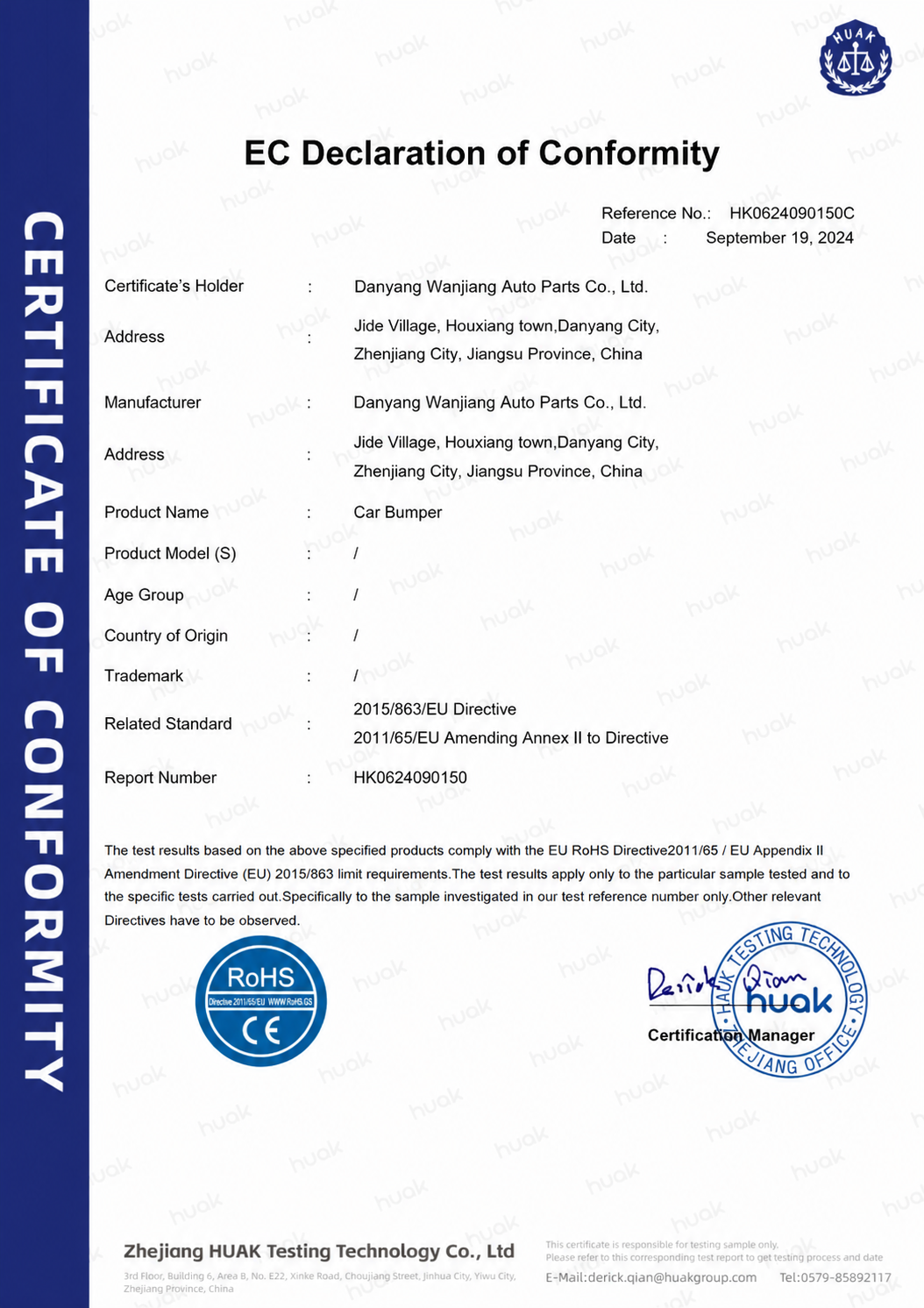
Compliance evidence should remain connected to the shipment file. Danyang Wanjiang Auto Parts Co., Ltd. holds a CE certification for car bumpers, certificate HK0624090150C, and an EPR certification covering car bumpers, car lamps, car hood bonnets, car fenders, and car grilles. These certifications support documentation control but do not replace shipment-level inspection.
For stock products, the business model states that loading and dispatch can be completed within one week. OEM/ODM timing depends on mold creation, craftsmanship complexity, and order volume. This makes pre-shipment inspection and written defect definitions particularly important when the buyer is working against a fixed replenishment schedule.
Data/Solution Comparison
| Inspection or control area | Acceptance approach | Shipment action |
|---|---|---|
| Structural and material performance | Verify material strength and impact resistance against the agreed product requirements | Reject when safety performance may be affected |
| Fitment and dimensions | Use dimensional measurement and mold-process monitoring to verify vehicle compatibility | Reject when installation or vehicle compatibility may be affected |
| Appearance and coating | Use visual inspection and paint or coating testing against the approved visual standard | Accept only within the documented cosmetic limit; otherwise hold for review |
| Final shipment condition | Inspect 100% of finished goods before loading | Release only inspected goods and retain videos or pictures when requested |
Frequently Asked Questions (FAQ)
Should I use a fixed defect percentage for rear bumper shipments?
No fixed rear-bumper defect percentage is provided in the available data. Define acceptance by defect type and consequence, with safety, fitment, dimensional, and compliance-related defects treated as unacceptable.
What inspections should be included before shipment?
Use visual inspection, dimensional measurement, and paint and coating testing. The company’s process also includes raw-material verification, production-process monitoring, and 100% final inspection before loading.
What should happen if a manufacturing defect is found after delivery?
When a quality or fitment issue is caused by manufacturing, the stated after-sales policy covers replacement, re-shipping, and associated expenses. The supplier also provides a 24-hour response for international inquiries and technical solutions within 48 hours.
Final Conclusion & Recommendations
Set the rear bumper threshold with a buyer-approved written standard, reject defects affecting safety or fitment, and use 100% final inspection supported by inspection records, videos, or pictures. Include CE and EPR documentation where applicable, and coordinate the quality release with stock, OEM/ODM, and shipping-agent arrangements. For detailed technical solutions or support, please reach out to us via sales01@cnkebel.com.
About Us
Danyang Wanjiang Auto Parts Co., Ltd. is a factory in Danyang, Jiangsu Province, and a professional exporter of auto body parts specializing in car bumpers, with other products including car grilles, headlights, engine hoods, and car fenders. Established in 2023, the company operates a 10,000 sqm factory and serves American and European markets. Its CE certifications include car bumpers and car lamps, and its cooperation cases cover international wholesalers, distributors, collision-repair chains, and cross-border automotive parts sellers.

Lastest
-
Can you manufacture a front bumper based on our proprietary 3D CAD files?
2026-09-06 -
Can you provide the DOT and SAE certification documents for this rear bumper?
2026-09-06 -
How many production lines do you dedicate to making this bumper upper?
2026-09-06 -
Is there an online portal to track aftermarket support for the front bumper assembly?
2026-09-06 -
What is the standard production lead time for a container of engine hoods?
2026-09-06
SUBSCRIBE
INQUIRY