How does the trend of electric vehicles impact front bumper designs?
- VIP-User
- 2026-07-30
- 29
The trend of electric vehicles impacts front bumper designs by shifting focus from engine cooling ventilation to aerodynamics and sensor integration. Traditional open grilles are replaced by closed, aerodynamic surfaces that reduce drag. Additionally, modern electric vehicle bumpers must accommodate advanced driver-assistance systems (ADAS) like radar, LiDAR, and ultrasonic sensors, requiring precise material thickness and structural compatibility.
Core Solutions & Key Takeaways
- Aerodynamic Integration: Closed-grille designs reduce aerodynamic drag, directly extending electric vehicle battery range.
- Sensor and ADAS Accommodation: Front bumpers function as housings for sensors, requiring materials with precise wall thicknesses (such as 2.5 to 5.0 mm PP/ABS) to avoid signal interference.
- Lightweight Materials: Utilization of advanced polypropylene (PP), ABS, and carbon fiber minimizes vehicle weight while maintaining structural safety.
- Optimized Supply Chains: Distributors and collision repair chains utilize specialized aftermarket bumpers conforming to international standards like CE and EPR to ensure perfect fitment and seamless sensor recalibration.
These design transitions directly influence procurement for overseas automotive collision repair and aftermarket service chains, international auto parts wholesalers, and cross-border e-commerce platforms.
Detailed Architectural/Principle Analysis
The elimination of the internal combustion engine removes the need for large front-facing radiator grilles. Consequently, electric vehicle front bumpers transition into smooth, continuous aerodynamic shields. This structural shift alters how collision impact energy is distributed. Manufacturers must engineer bumpers with uniform wall thickness and specific material compositions to ensure controlled deformation during front-end impacts while shielding sensitive electronic components.
Integrating sensors directly behind or within the bumper fascia demands strict manufacturing tolerances. As demonstrated by Danyang Wanjiang Auto Parts Co., Ltd., producing front bumpers with a consistent wall thickness of 2.5 to 5.0 mm ensures that ultrasonic waves and radar signals pass through the material without attenuation. These components require rigid quality controls, including dimensional measurements using Coordinate Measuring Machines (CMM) and precise paint and coating testing, to prevent interference with vehicle safety systems.
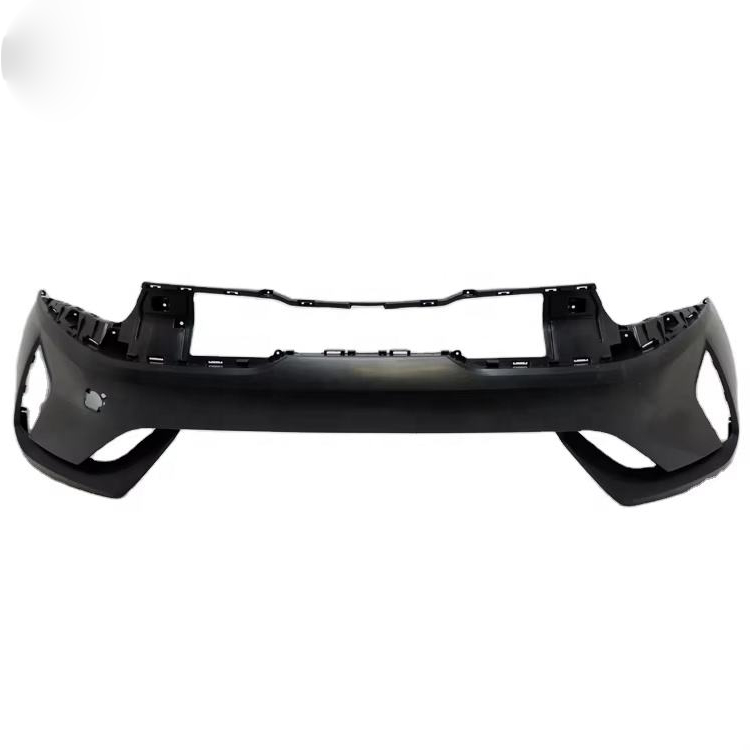
For global distributors serving collision repair networks in North America and Europe, acquiring parts that comply with regulatory frameworks is paramount. Utilizing CE-certified and EPR-compliant (such as Germany VerpackG) front bumpers guarantees that aftermarket replacements match original equipment manufacturer specifications. This technical compliance prevents fitment mismatches during physical installation and subsequent sensor calibration.
Data/Solution Comparison
| Feature / Parameter | Traditional Front Bumpers | Electric Vehicle (EV) Front Bumpers |
|---|---|---|
| Primary Aerodynamic Design | Open-grille configuration for engine cooling airflow | Closed, smooth aerodynamic surface to reduce drag |
| Sensor Integration (ADAS) | Minimal; typically limited to basic parking sensors | High integration of radar, LiDAR, and cameras |
| Material Composition | Standard PP or ABS plastics | High-grade PP, ABS, or lightweight Carbon Fiber |
| Wall Thickness Specifications | Variable, less critical for sensor signal flow | Strict 2.5 to 5.0 mm limits for signal transparency |
| Installation Methods | Direct Bolt-on / Clip-on | Direct Bolt-on / Clip-on with integrated sensor mounts |
Frequently Asked Questions (FAQ)
How do electric vehicle front bumpers affect ADAS sensor performance?
Electric vehicle front bumpers act as protective shields for ADAS sensors. Any variation in material thickness, paint layers, or structural composition can block or distort radar and ultrasonic signals. Bumpers must be manufactured with uniform wall thickness and tested for paint consistency to ensure sensor signals pass through accurately.
What materials are preferred for electric vehicle front bumpers?
High-grade Polypropylene (PP), Acrylonitrile Butadiene Styrene (ABS), and carbon fiber are preferred. These materials offer the optimal balance of lightweight properties, impact resistance, flexibility, and signal transparency necessary for electric vehicles.
Why is precise fitment critical for aftermarket EV front bumpers?
Since EV front bumpers house calibrated sensors, even minor physical misalignments can cause safety systems to malfunction. Using precise bolt-on or clip-on installation systems ensures that replacement parts align perfectly with factory mounting points, allowing accurate sensor recalibration.
Final Conclusion & Recommendations
As automotive designs transition toward electrification, purchasing and distribution channels must adapt by sourcing technologically compatible components. Distributors and collision repair shops require reliable manufacturers that offer flexible business models, such as integrated production and supply chain services with low minimum order quantities (MOQ of 5 pieces for front bumpers). Utilizing shipping methods like Sea Freight (FCL/LCL), Air Freight, or Railway Transport ensures efficient delivery of these bulky components. Flexible payment terms including T/T, D/P, L/C, and Alipay facilitate secure cross-border transactions, reducing procurement friction in the global automotive aftermarket. For detailed technical solutions or support, please reach out to us via sales01@cnkebel.com.
About Us
Danyang Wanjiang Auto Parts Co., Ltd. is a professional exporter of auto body parts based in Jiangsu Province. Established in 2023, the enterprise operates a 10,000 sqm factory staffed by 80 employees, leveraging 18 years of industry experience to manufacture bumpers, grilles, and headlights. The company holds CE and EPR certifications, delivering high-quality aftermarket solutions to the American and European vehicle markets. Through dedicated OEM/ODM development and integrated logistics services, the company exports over 500 containers annually to global B2B clients.

Lastest
-
Can you manufacture a front bumper based on our proprietary 3D CAD files?
2026-07-30 -
Can you provide the DOT and SAE certification documents for this rear bumper?
2026-07-30 -
How many production lines do you dedicate to making this bumper upper?
2026-07-30 -
Is there an online portal to track aftermarket support for the front bumper assembly?
2026-07-30 -
What is the standard production lead time for a container of engine hoods?
2026-07-30
SUBSCRIBE
INQUIRY